Monday, September 15, 2014

SIX THINGS THE US DEPT OF EDUCATION DID TO DEPRIVE YOUR CHILD OF PRIVACY

SIX THINGS THE US DEPT OF EDUCATION DID TO DEPRIVE YOUR CHILD OF PRIVACY

The story of Common Core and data mining begins as most stories do, with a huge, unmet need.

Self-appointed “stakeholder” know-it-alls at the federal level (also at state, corporate, and even university levels) determined that they had the right, and the need, for open access to personal student data– more so than they already had.

They needed state school systems to voluntarily agree to common data core standards AND to common learning standards to make data comparisons easy. They didn’t care what the standards were, as teachers and parents and students do; they only cared that the standards would be the same across the nation.

So, without waiting around for a proper vote, they did it. The CEDS (Common Education Data Standards) were created by the same people who created and copyrighted Common Core: the Council of Chief State School Officers (CCSSO). No surprise.

CEDS common elements

Because the federal “need” to control schools and data was and is illegal and unconstitutional –the federal government “needed” to do (and did) at least six sneaky things.

SIX SNEAKY THINGS THE U.S. DEPARTMENT OF EDUCATION DID TO DEPRIVE YOUR CHILD OF PRIVACY:

1. Sneaky Thing Number One: It bribed the states with ARRA Stimulus monies to build 50 linkable, twinlike State Longitudinal Database Systems (SLDS). This act created a virtual national database.

These SLDS’s had to be interoperable within states and outside states with a State Interoperability FrameworkUtah, for example, accepted $9.6 million to create Utah’s SLDS. Think about it. All states have an SLDS, and they are built to be interoperable. How is this not a de facto national database?

2. Sneaky Thing Number Two: It altered the (previously privacy-protective) federal FERPA (Family Educational Rights Privacy Act) law to make access to personally identifiable student data –including biological and behavioral data– “legal”.

So now, the act of requiring parental consent (to share personally identifiable information) has been reduced from a requirement to just a “best practice” according to the altered federal FERPA regulations.

Best practice FERPA

For more information on this, study the lawsuit against the Department of Education by the Electronic Information Privacy Center (EPIC).

The Department of Ed also altered FERPA’s definitions of terms, including what would be defined as “personally identifiable information”.

Biometric Definition FEDERAL

So personally identifiable, shareable information now includes biometric information, (which is behavioral and biological information) collected via testing, palm scanning or iris scanning, or any other means. Schools have not been told that the information they submit to the state SLDS systems are vulnerable to federal and corporate perusal. Legislators write bills that call for the testing of behavioral indicators– but have they considered how this can damage a student’s lifelong need for, and right to, privacy?

The Department of Education openly promotes schools collecting data about students’ personalities and beliefs in the report called “Promoting Grit, Tenacity and Perserverance.” This document promotes the use of facial expression cameras, posture analysis seats, wireless skin conductance sensors and other measures of students’ beliefs and emotions. See page 44.

3. Sneaky Thing Number Three: The US Department of Education partnered with private groups, including the CCSSO (that’s the Council of Chief State School Officers –copyright holders on Common Core–) to collect student data nationally.

The CCSSO, or “Superintendents’ Club” as I like to call it, is a private group with no accountability to voters. This makes it in-valid and un-American, as far as governance goes. The CCSSO has a stated mission: to disaggregate student data. Disaggregate means to take away anonymity.

CCSSO disaggregation

The CCSSO states that it has a mission to collect data nationally in partnership with the US Dept of Ed: “The Education Information Management Advisory Consortium (EIMAC) is CCSSO’s network of state education agency officials tasked with data collection and reporting; information system management and design; and assessment coordination. EIMAC advocates on behalf of states to reduce data collection burden and improve the overall quality of the data collected at the national level.

The CCSSO site states that its data collection effort is a USDOE partnership: “The Common Education Data Standards Initiative is a joint effort by CCSSO and the State Higher Education Executive Officers (SHEEO) in partnership with the United Staes Department of Education.”

(Do you recall voting for this arrangement, anyone? Anyone? –Me neither! )

4. Sneaky Thing Number Four: It used private-public partnerships to promote data linking among agencies. The Data Quality Campaign is one example. The National Data Collection Model is another example. The Common Educational Data Standards is another example.

What do these “models” really model?

Example one: from the Data Quality Campaign: “as states build and enhance K12 longitudinal data systems they continue building linkages to exchange and use information across early childhood, postsecondary and the workforce and with other critical agencies such as health, social services and criminal justice systems.”

Let that sink in: linking data from schools, medical clinics, and criminal justice systems is the goal of the Federal-to-CCSSO partnership. So nothing will be kept from any governmental agency; nothing is to be sacred or private if it is known by an SLDS serving entity (any state-funded, state-accountable school).

Example two: from the National Data Collection Model:

your child’s name
nickname
religious affiliation
birthdate
ability grouping
GPA
physical characteristics
IEP
attendance
telephone number
bus stop times
allergies
diseases
languages and dialects spoken
number of attempts at a given assignment
delinquent status
referral date
nonschool activity involvement
meal type
screen name
maternal last name
voting status
martial status
– and even cause of death.

Proponents point out that this is not mandatory federal data collection. True; not yet. But it’s a federally partnered data model and many states are following it.

5. Sneaky Thing Number Five: The Department of Ed created grants for Common Core testing and then mandated that those testing groups synchronize their tests, report fully and often to the U.S. Department of Education, share student-level data, and produce “all student-level data in a manner consistent with an industry-recognized open-licensed interoperability standard that is approved by the Department”.

So federally funded Common Core tests require Common data interoperability standards.

Check out that Cooperative Agreement document here.

But, do you think this “Agreement” information does not apply to you because your state dropped its SBAC or PARCC membership –as several states have? Think again. There is an incestuous, horrific pool of private and public organizations, all of which are VOLUNTARILY agreeing to Common Core based, technological interoperability and data collection standards!

The Data Quality Campaign lists as its partners dozens of groups– not only the CCSSO and NGA (Common Core creators), not only the College Board –which is now run by the lead architect of Common Core, David Coleman; –not only Achieve, Inc., the group that contracted with CCSSO/NGO to write the Common Core, but even the School Interoperability Framework Association, the Pell Institute (Pell Grants), Jeb Bush’s Foundation for Excellence in Education, American Institutes for Research (Utah’s Common Core testing provider) and many other Common Core product-providing organizations.

So virtually everyone’s doing data the same way whether they’re privately or publically funded. This should freak anybody out. It really should. We the People, individuals, are losing personal power to these public-private partnerships that cannot be un-elected and that are not subject to the transparency laws of elected offices.

6. Sneaky Thing Number Six: The Department of Education directly lied to the American Society of News Editors. In a June 2013 speech given to the American Society of News Editors, Secretary Duncan mocked the concerns of parents and educators who are fighting Common Core and its related student data mining:

A new set of standards — rigorous, high-quality learning standards, developed and led by a group of governors and state education chiefs — are under attack as a federal takeover of the schools. And your role in sorting out truth from nonsense is really important… They make.. outlandish claims. They say that the Common Core calls for federal collection of student data. For the record, we are not allowed to, and we won’t. And let’s not even get into the really wacky stuff: mind control, robots, and biometric brain mapping. This work is interesting, but frankly, not that interesting.”

Despite what the state school board and the federal Department of Education claim, corporations do know that Common Core and student data mining are interdependent.

CEO of Escholar Shawn Bay spoke at a recent White House event called “Datapalooza.” He said (see his speech on this video, at about minute 9:15) that Common Core “is the glue that actually ties everything together” for student data collection.

And President Obama himself has called his educational and data related reforms so huge that they are cradle to career” -affecting reforms. Secretary Duncan now refers to the reforms not as “K-12″ but as “p-12″ meaning preschool/prenatal. These reforms affect the most vulnerable, but not in a positive way, and certainly not with voters’ knowledge and consent.

The sneakiness and the privacy invasion isn’t just a federal wrong; there’s state-level invasion of local control, too: to be specific, our state’s robbing parents of the right to fully govern their own children.

When I asked my state school board how to opt out of having my children tracked by the State Longitudinal Database System, I was told that the answer was no. There was no way to opt out, they said: all children registered in any state school system (charters, online schools, homeschool-state hybrid programs) are tracked by the SLDS. Here’s that letter.
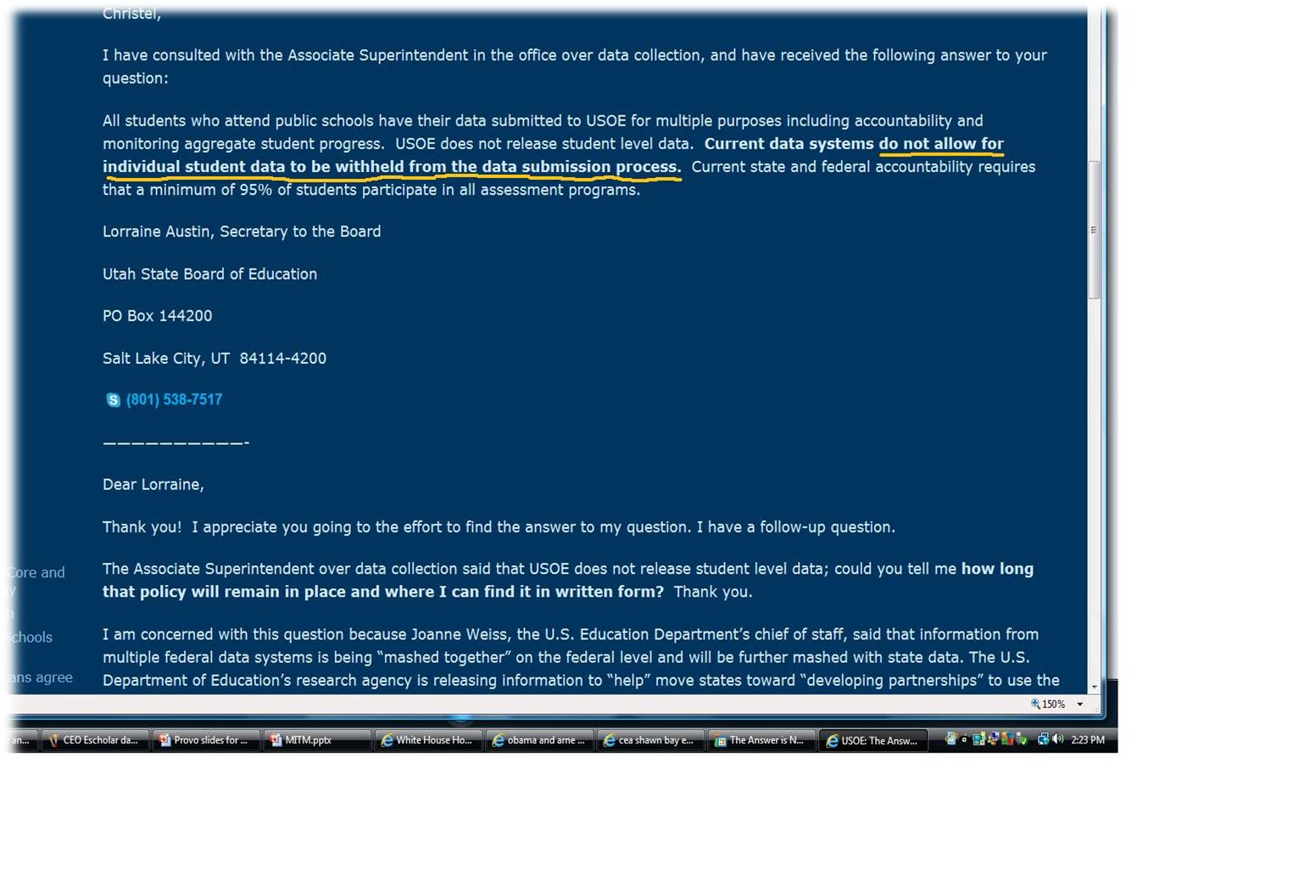
The Answer is No

Despite Constitutional and G.E.P.A.-law prohibitions, Secretary of Education Arne Duncan admitted that “The Obama administration has sought to fundamentally shift the federal role, so that the Department is doing much more”. Duncan also said, “America is now in the midst of a “quiet revolution” in school reform.” (Yes, it’s been so quiet that the people governed by it weren’t asked about this revolution.)

Yet, federal speeches, and scholarly research conferences and corporate marketers now openly push for common standards and common data systems. From the official White House website to federal educational grant applications to federally partnered corporate sites, to Secretary Duncan’s speeches, there are countless examples to show that the priorities of the federal government are these four things1) standards 2) staff 3) “robust” national data systems 4) labeling certain schools as low-achieving.

And the data product sales companies couldn’t agree more.

Common Core proponents insist that Common Core has nothing to do with data mining. But the federal government always bundles the common standards and the data systems, always. This federal push for common data standards and common education standards ought to be household knowledge. That is step number one, seeing the federal patterns and federal pushes for what they are.

EDFACTS

So, what difference does it make? I hear people say that since they have nothing to hide, they’re unconcerned about who’s tracking their children or their families without consent.

I say our founding fathers didn’t write the Constitution without inspiration.

The Constitution describes the God-given right to privacy:

“The right of the people to be secure in their persons, houses, papers, and effects, against unreasonable searches and seizures, shall not be violated, and no warrants shall issue, but upon probable cause, supported by oath or affirmation, and particularly describing the place to be searched, and the persons or things to be seized.”

How easy will it be for those with access to the national databases to label a person as behaviorally unstable and therefore, unworthy of passing a background check for a job or for a gun purchase? How easy will it be for those with access to the databases to search and seize anything at all that they deem inappropriate, that they deem threatening, that they deem theirs?

Privacy is not properly protected by our state school systems and those who ought to know this, don’t. It’s not their fault; the truth has been carefully, quietly hidden. But widespread knowledge of the facts can –and must-- alter these facts.

Please share.

———————————————————-

Postscript: About Control

State school boards tell citizens to give them feedback on the Common Core Standards, and not to discuss anything else related to Common Core or its governance structures.

But citizens have the right to determine what will be discussed; this is America. And any discussion of the standards themselves can only be very temporarily relevant.

Why is academic argument about Common Core only temporarily relevant?

Because two private D.C. trade groups, the NGA (Governors’ club) and the CCSSO (Superintendents’ club) own the standards and have copyrighted them. They alone control the standards. The states do not; nor do the voters in the states.

Inside the state: We can alter the standards only by 15%, according to federal mandates and the writings of the private trade groups that created the standards.

Outside the state: We have no voice in future alterations to the standards. There is no written amendment process outlined for states to have a voice in “their” standards. There is no representative process. That’s why Common Core is unAmerican.

This is why we call Common Core education without representation. It is also accurate to call the education reform package citizen surveillance without warrant, as detailed above.

—————-

For a 15-minute crash-course on the connection between Common Core and student data mining, watch this video by Jane Robbins of the American Principles Project:


Sent from my iPhone

WHAT THE COMMON CORE WILL DO TO COLLEGES

WHAT THE COMMON CORE WILL DO TO COLLEGES

common_core_blog.jpg

Changes in the SAT, announced on March 5 by the College Board, adjust the test to the ongoing decline in the nation’s public schools. The new test lightens vocabulary and math and eliminates the penalty for bad guessing. The new SAT grows out of and accommodates the Common Core State Standards, the controversial set of K-12 standards adopted by 45 states and the District of Columbia.

The Common Core’s standards amount to an assault on the college curriculum. That’s because colleges will have to adapt to what the Common Core teaches–and what it fails to teach. It teaches a mechanical way of reading that is poorly suited to literature, philosophy, history, and the rest of the liberal arts.  It also fails to teach the math students need to begin a college-level curriculum in the sciences.

Complaints

The Common Core has aroused a broad-based and sometimes furious reaction among Americans across the political spectrum. The furor, however, isn’t yet focused on what the Common Core does to a college education. Rather, the complaints focus on the immediate harm to students and to schools. The arguments against Common Core have proliferated almost beyond counting, but the short version is something like this:

The Race to the Middle.  The Common Core promises higher academic standards in the nation’s schools.  In some cases it will deliver on that promise, but in other cases, the Common Core actually lowers standards.  The whole thing is an experiment in social leveling.

Goodbye Local Control.  The Common Core transfers a lot of power over the nation’s schools from local districts and state governments to the federal government.  The transfer is deceptive and probably illegal. The deception comes from the Common Core being sold as “voluntarily” adopted by the states. The illegality comes from statutory law that prohibits the federal government’s involvement in creating school curricula.

Big Brother. The Common Core is designed to collect and aggregate an immense amount of data on individual students’ academic performance. Critics worry that this will eventuate in detailed federal files on everyone who attends school.

Other objections focus on the Common Core’s utilitarian goals.  Common Core emphasizes “informational texts” at the expense of literature, promotes out-of-context reading, and significantly lowers expectations for students in math. The Common Core is designed to expedite the way students work, and it minimizes just about everything else schools might be expected to do, such as develop creativity, foster a fullness of mind, and strengthen character.

Common Core was sold to the states as a way to make students “college ready.”  The sales pitch was that our nation’s schools do a mediocre to poor job prepping students for the next leg of the journey to adulthood–the leg that will take them through Chem 101, English Lit, or whatever college “first years” now take.

Like all good sales pitches, this one was grounded in truth. Our schools don’t do an especially good job at preparing students for college.  As anyone (including me) who has taught freshmen at a “selective” college or university can attest, a great many students arrive at college with no capacity to write a short essay.  Many cannot reliably compose even a grammatical sentence.  Their knowledge of history and literature is generally many steps below what students twenty years ago brought with them, and twenty years ago was a big step down from twenty years before that. Preparation in mathematics and basic science has plummeted even further.

That said, each semester a handful of students would turn out to be capable and disciplined writers who were pretty well-informed on the things we college teachers used to be able to take for granted.  Some are from elite academies or exceptional public schools.  But a growing number are homeschooled.

So when Common Core’s proponents announced that they were serious about remaking our public schools into places where students would graduate “college ready,” the American public was primed to say, “It’s about time.”

Ready or Not

But a good sales pitch isn’t the same as a good product.  As we have gotten to see the Common Core up close, it looks less and less likely to yield “college ready students” in the way we hoped.

The Common Core will in all likelihood improve education for some students.  How many, what percentage, where, at what cost, and with what drawbacks?  The whole thing has been rushed into place so quickly that no one really knows. But a few things have become clear:

Locking In Mediocrity.  The Obama administration’s way of fast-tracking the Common Core through state approval was the $4.35 billion “Race to the Top.” To qualify to get into the competition for these funds, states had to agree in advance that students who complete a Common Core curriculum would be admitted to public colleges and universities as full-fledged students. Such students will be exempt from having to take remedial courses because, after all, the state has pre-certified them as “college ready.”  What part of “college ready” do those professors not understand?  If the students aren’t “ready” to write college essays, so much the worse for college essays.

I doubt that the bureaucrats and state legislators who approved this stipulation gave a moment’s thought to what this arrangement really means. Thanks to various “preference” programs in college admissions–for racial minorities principally but also for athletes and other “special interests”–colleges admit many students who are mismatched to the prevailing level of academic rigor. The usual recourse for these students has been an effort to repair the gaps in their learning through remedial courses, which are usually non-credit courses, i.e. they don’t count towards graduation. They are on-ramps for students who are not yet ready for freshman courses.

The Common Core, in a stroke, abolishes this option. If a college admits students who are mismatched, it will have no choice but to mainstream those students into regular courses.

Colleges could decide not to admit such students at all or admit them and watch them fail. But given higher education’s steely commitment to using college admissions to advance its ideas of “social justice,” most colleges will simply lower academic standards across the board.  Note that this cannot stop with freshman year.  Once a college injects “underprepared” (i.e. incompetent) students into mainstream introductory courses and adjusts those courses to avoid embarrassingly high failure rates, the consequences will propagate through all the subsequent courses.

Subterfuges will necessarily evolve.  Colleges will create or expand “honors” programs for students who meet what were formerly the basic standards.  Remedial courses will be relabeled as regular courses, even though everyone will know they are remedial. Untalented students will be shunted even more than they are now to soft majors in fields such as African-American studies, sociology, and women’s studies.

But such subterfuges will be targets for severe criticism by the academic left on the grounds that they discriminate. The emergence too conspicuously of a two-tier system would be denounced as racist, classist, anti-immigrant, and so on. The only viable choice for most colleges and universities will be to dilute the curriculum.  The Common Core is thus set to become a bulldozer aimed at leveling what remains of intellectual excellence in American higher education.

Remedial courses, I might add, have themselves become a blight in American higher education, but that’s a topic for another day.

Locking Out Liberal Learning.  The Common Core emphasizes how to glean information from the written word–and other media as well. The catchphrase that the Common Core uses for the written words that students will mine for information is “informational texts.”  Think of the recipe on the back of the soup can for turning soup into a tasty casserole. But not all “informational texts” present themselves as instructions. “Information” can be gleaned from all sorts of texts, including picture books, novels, poems, YouTube videos, works of history, and speeches by notables such as Abraham Lincoln.

The trouble is that if you see the written word as mainly a device for conveying information, you miss many other things that writing can do. It stirs emotions; it points to truths beyond itself; alternatively, it conveys lies; it may possess beauty or it may be ugly; it can cause us to ask questions that the text itself does not ask; it possesses implications; it belongs to and participates in a larger context; it taps into secret memories; it rallies us to public causes.

The Common Core slights all of these purposes.  That is not to say it ignores them entirely. It gives some small space to mythology and literature–a space that retracts year by year as students progress through the Common Core.

Why should this matter?  We should surely want students to be able to read recipes on soup cans and to extract important information from “texts.”  That’s a useful skill.  But it is a skill that, cultivated at the expense of a more well-rounded form of literacy, cuts students off from the foundation of a liberal education. Students who know how to read “informational texts,” and to read every piece of writing as though it is an “informational text,” are ill-prepared for Plato’s Republic or Shakespeare’s King Lear. Indeed, they are ill-prepared for Goodnight Moon.

This gap between how the Common Core teaches students to read and the kind of reading required in a liberal education is especially worrisome at a time when colleges have to a great extent abandoned their old core curricula.  Students these days are lulled with the illusion that they can become “critical thinkers” by studying whatever catches their interest, rather than what their colleges have deemed the most important works. That whole do-it-yourself approach puts a premium on the capacity of college students to read with their eyes wide open and to get to places well beyond the “information” that a “text” lays out.

With the Common Core, we will have the worst of both worlds: students who come equipped to read mainly for information and college curricula designed for students equipped mainly for independent intellectual synthesis.

Watering Down Math.  Common Core defers the teaching of algebra to the 9th grade.  As a consequence, it will be difficult for schools to offer pre-calculus to students before they finish high school. There simply isn’t enough time left in the curriculum to reach that level, and the Common Core poses other obstacles as well. Trigonometry is barely broached. Geometry follows an eccentric path. The result is that students who go to college hoping to study the physical sciences, computing, engineering, economics, and other math-heavy fields will be handicapped.  Or they will have to scramble before they get to college to supplement what their high schools offer.

Some students will find their ways around these obstacles, but many won’t, and that will leave colleges and universities with few good choices.  The likeliest path will be to reduce the rigor of their science programs to accommodate students who have to spend their first year catching up on mathematics that used to be taught in high school.

Everybody acknowledges how important the STEM fields are for America’s future–and few are more vocal about this than Bill Gates. One of the ironies of the Common Core is that its most lavish-spending advocate is contributing to the further erosion of our nation’s strength in this area.  Perhaps it is no wonder that Mr. Gates is also a major supporter of increasing the number of H-1B visas for foreign nationals who have expertise in science and engineering.

What Else?

The Common Core will not make an appreciable number of students more “college ready.” It may smooth the way, however, for more students to be admitted to college. President Obama and Michelle Obama have recently ratcheted up the campaign that Obama announced back in his first address to Congress in February 2009–to make America the nation with the highest percentage of college graduates. The pitch that “everyone should go to college” has been a favorite of American politicians for a long time. It is, on its face, silly. To achieve anything like it would require obliterating academic standards and wasting untold trillions of dollars. But the phrase somehow strokes the national ego.

The Common Core feeds this fantasy and the illusions buried within, namely, that a college degree is a ticket to personal prosperity and that having lots of people who have college degrees necessarily makes the nation more competitive in the global economy. For reference: the nation that currently has the greatest percentage of college degrees in its population is that economic powerhouse, Russia. Moreover, the nation with the strongest economy in Europe–Germany–has about half the percentage of college-degreed people as the United States does.

So the effort to grease the skids from public school to college is founded on a mistake.  But it is a mistake that Americans somehow cherish and won’t easily relinquish.  We would go a lot further towards both a greater degree of personal prosperity and national competitiveness if we really did improve K-12 education–not with the idea of making our schools operate better as conveyor belts to our languishing higher education institutions, but with the idea of fostering a true spirit of educational achievement among students, parents, and teachers. I know.  Easier said than done.

The task at hand, however, is to stop the Common Core before it can inflict more harm.  The battle will probably be waged over the issues I listed earlier–the race to the middle, goodbye local control, big brother–during the races for public office in which the Common Core becomes an issue.  But the Common Core is also an assault on higher education and as that becomes clear perhaps the strange coalition of opponents will grow stranger still.  I await the rallies where Tea Party activists unite in uncommon cause with English and History profs.

(Photo Credit: IEW.)


 8  0  0  65  0


BILL BENNETT SCHOOLED ON COMMIN CORE


BILL, YOU’RE WRONG ABOUT COMMON CORE’

For years, Bill Bennett, former U.S. Secretary of Education, has avoided taking a position on the Common Core K-12 State Standards.  But yesterday he declared himself in favor. His essay in The Wall Street Journal, under the headline “The Conservative Case for Common Core,” dwells on the idea that conservatives generally favor good books, shared truths, and education that equips students with basic math and the ability to “read and distill complex sentences Bennett drives the point that “certain abilities” ought to be “common knowledge of all.” Just so. But then he proceeds as though “common knowledge” and “The Common Core™” are one and the same. They’re not.

He writes that “the fundamental idea behind a core curriculum” is “preserving and emphasizing what’s essential.” A true core curriculum does preserve and emphasize the “essential” in contrast to the merely trendy, the happenstance, the contingent, the experimental, and the trivial.  That doesn’t mean that everything that hoists the flag of “core curriculum” really is “core curriculum.”  Look around American higher education today and you can barely help crashing into “core curricula” that are barely distinguishable from swarms of intellectual gnats.  Bill Bennett knows that about as well as anyone.

Related: What the Common Core Will Do to Colleges

The Common Core K-12 Curriculum isn’t a congregation of gnats, but it is astonishingly experimental.  It does not build on “essential” knowledge. Rather it ventures out on the thin, thin ice of conjectural innovation, as its highly unusual approaches to elementary instruction in math and its novel approach to geometry.  This isn’t the place to go into details, but the weirdness of the Common Core’s approach to math has been widely remarked by parents and roundly excoriated by mathematicians.  It actively hinders students from learning mathematical shortcuts, and tried and true techniques in favor immersing them in number theory.

I expect a certain kind of mathematical pedant likes the Common Core approach:  mathematicians of this sort don’t want students merely to learn how to do math; they want each and every student to contemplate the deep why of math.  My own view is that in most cases, learning how precedes learning why.  We don’t need to teach children the laws of physics to teach them how to ride bikes.

Related: Common Core Mandates Will Harm Critical Thinking

Bennett offers more of this sort of misdirection and then turns to another bad argument—the idea that the Common Core really is, despite the Obama administration’s attempt to hijack it, deep down a state-level initiative.   The supposed evidence for this is that the Common Core was in play before Obama made it his own and 45 states “signed up originally.”  What actually happened is that the National Governors Association and the Council of Chief State School Officers, backed by a boatload of Gates Foundation money, drew expressions of preliminary interest from all those states.  It was an idea in development, and there were no standards even in draft form for the states to see.  What was in play was a lot of loose rhetoric.

Or you could go back and read some of the original writings by David Coleman, the primary architect of the Common Core, and his colleagues.  But if you did, you would have a hard time saying that the Common Core was ever a “conservative idea.”  It began as a proposal for lowering academic standards in the hope that simpler and easier benchmarks would permit larger numbers of students to move ahead, undiscouraged by anything like actual difficulty.  One of Coleman’s brilliant rhetorical innovations was his decision to call this dumbing down “higher standards” on the grounds that they would permit higher numbers of students to pass.

Bennett assures us that the federal usurpation of the Common Core is a temporary thing and can, in the fullness of time, be undone.  The state-level voluntary character of the Common Core can be restored.  That’s a fantasy.  The Common Core was meant from the get-go to replace state and local autonomy with national control.  It was designed that way and federal control is intrinsic to it.  Of course, if you like the federal educrats running the curriculum with the aid of a couple of privately held testing consortia and the enthusiastic support of some textbook mega-publishers, the Common Core may be your thing.  But to imagine it as a “conservative” undertaking is to imagine what never was and will never be.

 64  24  0  100  3


Thursday, September 11, 2014

Condemning the Teaching of Common Core Math Concepts


IFI Condemns the Teaching of Math Concepts? Say It Ain’t So | Illinois Family Institute
IFI Condemns the Teaching of Math Concepts? Say It Ain’t So

Last Saturday, IFI posted a video from a news program that purported to demonstrate teaching math the Common Core way. This video had been and continues to be widely circulated on conservative websites like Daily Caller and shown on television programs like John Stossel’s program Stossel and Red Eye with Greg Gutfeld.

We received a few critical email messages from IFI subscribers who either misunderstood our motives for posting it or perhaps are unamused by satire (including inadvertent satire). So, I would like to clarify why we posted it, what the video demonstrates about Common Core that we believe warrants criticism, and what we are not criticizing:

1.  The reason we posted it is the same reason it is circulating: It is—to many viewers—funny. It is funny because it is (inadvertently) satirical. Satire mocks phenomenon—not because the phenomenon is wholly flawed—but because some aspect of it is flawed.

2.  The video is funny because it draws attention to two common criticisms of Common Core. It draws attention to the criticism that Common Core de-emphasizes memorization and that it overcomplicates the teaching of subject matter through confusing explanations and education jargon. While the method demonstrated in the video is touted as making addition problems easier, the way the teacher explained it in this particular video would be confusing to young children—and many adults.

Perhaps the teacher’s poor explanation derived from the limited time she had available or perhaps from the Common Core language (i.e., “anchoring” and “decomposing”), but nonetheless, many people find the demonstration amusing.

Two of our critics, while agreeing that the teacher’s explanation was inadequate and the language inappropriate, found nothing funny about it. I would agree that if the funny parts were taken out, it wouldn’t be funny.

Many viewers who are amused by the video are also troubled by it. They’re troubled by Common Core’s apparent de-emphasis on memorization of facts (and not just in math), which this video reinforces. Even the interviewer’s introduction reinforces the public’s concern with Common Core’s de-emphasis on memorization.

Click here to see an even funnier video of a Grayslake, Illinois math teacher making that point explicitly. Just to be clear, my posting of this video should not be interpreted as a criticism of requiring students to explain their reasoning. It is a criticism of an apparent de-emphasis on math facts—which many students learn, develop facility with, and retain through memorization.

3.  The reason IFI posted the video on Saturday is not that we find the strategy the teacher is using inherently problematic. Nor do we oppose the teaching of base 10, or the teaching of  mathematical concepts, principles, and strategies that facilitate both comprehension and computation. IFI heartily and unequivocally endorses the teaching of math concepts, principles, strategies, facts—and satire (including inadvertent satire).

Those of you who enjoy a dollop of lighthearted satire following a more substantive meal of propositional argumentation (heavy on nutritional evidence), pick up your dessert spoon and taste this: “Ten Dumbest Common Core Problems.”


Wednesday, September 10, 2014

WHAT IS A CHARTER SYSTEM PUBLIC SCHOOL

Barrow County Ga PDF
WHAT IS A CHARTER SCHOOL SYSTEM


FAQ's by UnCommonSchools.org
http://www.uncommonschools.org/faq-what-is-charter-school
Frequently Asked Questions About Public, Charter Schools

What is a charter school?

A charter school is an independently run public school granted greater flexibility in its operations, in return for greater accountability for performance. The "charter" establishing each school is a performance contract detailing the school's mission, program, students served, performance goals, and methods of assessment.

What is the difference between charter schools and other public schools?

Charter schools are public schools of choice, meaning that families choose them for their children. They operate with freedom from some of the regulations that are imposed upon district schools. Charter schools are accountable for academic results and for upholding the promises made in their charters. They must demonstrate performance in the areas of academic achievement, financial management, and organizational stability. If a charter school does not meet performance goals, it may be closed.

Are charter schools all the same?

No. Charter schools can vary a great deal in their design and in their results. Uncommon Schools creates schools based on the principles and practices that have proven successful in producing significant academic gains at high-performing urban charter public schools across the country.

Who authorizes charter schools?

This varies from state to state, depending on the state's charter law. In New York, there are three authorizers: the New York State Board of Regents, the State University of New York Board of Trustees, and local boards of education. In New Jersey, there is one authorizer, the state Commissioner of Education. In Massachusetts, the authorizer is the Board of Elementary and Secondary Education.

Who can start a charter school?

Parents, community leaders, social entrepreneurs, businesses, teachers, school districts, and municipalities can submit a charter school proposal to their state's charter authorizing entity.

Who attends charter schools? Whom do they serve?

Nationwide, students in charter schools have similar demographic characteristics to students in the local public schools. In some states, charter schools serve significantly higher percentages of minority or low-income students than the traditional public schools. Charter schools accept students by random, public lottery.

How are charter schools funded?

As public schools, charter schools are tuition-free. They are funded according to enrollment levels and receive public funds on a per pupil basis. In some states, such as Alaska, Colorado, Minnesota, and New Jersey, they receive less than 100% of the funds allocated to their traditional counterparts for school operations. In other states, such as California, additional funds or loans are made available to them. In most states, charters do not receive capital funds to support facility expenses. Charter schools are entitled to federal categorical funding for which their students are eligible, such as Title I and Special Education monies. Federal legislation provides grants to help charters to manage start-up costs.

What is a charter management organization?

Charter management organizations (CMOs), generally speaking, are organizations that contract with an individual school or schools to deliver management services. These services typically include curriculum development, assessment design, professional development, systems implementation, back-office services, teacher recruitment, and facility services. Uncommon Schools is a nonprofit CMO that contracts with individual charter school boards of trustees. Uncommon's "bottom line" is that each school achieves at the highest level. All decisions are made in the context of what is best for the individual school to ensure student achievement and outstanding academic results.

What makes the schools in Uncommon different from other schools?

Uncommon schools share the following key attributes: a college preparatory mission; high standards for academics and character; a highly structured learning environment; a longer school day and a longer school year; a focus on accountability and data-driven instruction; and a faculty of committed and talented leaders and teachers. Schools within the Uncommon network are modeled on some of the highest-performing urban public charter schools in the country.

How can I enroll my child at an Uncommon School?

Each school admits students through a random lottery. Based on legislation passed in 2007, all New York City charter schools, beginning in the 2008-9 school year, must give preference to students resident in the Community School District (CSD) in which the charter school is located. However, students who reside outside the CSD are eligible to apply and may be admitted if space permits. Please visit the individual school pages to learn more about the enrollment processes for Boston, New York City, Newark, Rochester, and Troy.

Do teachers need to be certified to work at an Uncommon school?

Certification requirements vary on a state-by-state basis. In New Jersey, all teachers must be certified, and Uncommon Schools helps teachers navigate the alternate route process to secure their teaching credentials. In New York, while the state does not require that 100% of teachers be certified at each charter school, the rules under the "No Child Left Behind" Law mean that teachers need to get their licenses with reasonable speed; Uncommon New York City is able to ensure that its teachers are enrolled in a Master's program that provides provisional certification and, more importantly, high quality training. In Massachusetts, charter school teachers must attain Highly Qualified teacher status as dictated by the "No Child Left Behind" Law by possessing a bachelor’s degree and demonstrating subject matter competence in the subjects they teach; Uncommon Boston encourages teachers to get certified and assists them in this process.

Links to More Information on Charter Schools in Massachusetts:


Links to More Information on Charter Schools in New Jersey:


Links to More Information on Charter Schools in New York:


Links to More Information on Charter Schools in the U.S.:


PARCC and SBAC States Agree to Deliver Student-level Data to USDOE

PARCC and SBAC States Agree to Deliver Student-level Data to USDOE

In September 2010, two assessment consortia “won” federal Race to the Top (RTTT) money for the “design, development, and evaluation of the assessment system” known as Race to the Top Assessment (RTTA): The Smarter Balanced Assessment Consortium (SBAC) and the Partnership for Assessment of Readiness for College and Careers (PARCC).

PARCC received $170 million, and SBAC, $160 million, plus an additional $16 million to each consortium to “support efforts to help participating States successfully transition to common standards and assessments.”

Their award letters can be found here for PARCC and here for SBAC.

In the award letters, both PARCC and SBAC were expected by January 7, 2011, to “negotiate and complete a final cooperative agreement” with the federal government regarding the usage of the “common standards” assessments.

The fine print for taking college-and-career-ready dough from the feds.

Both cooperative agreements can be found here for PARCC and here for SBAC.

I have heard individuals ask about whether one of the requirements of the Common Core State Standards (CCSS) is the release of student-level data to the federal government. I have heard pro-CCSS officials dismiss this idea as unfounded.

Not so.

PARCC and SBAC are the federally-funded, CCSS-assessment consortia. In order to receive those federal millions for CCSS assessment development, both consortia had to agree to deliver student-level data to USDOE.

Data is control, and USDOE wants control over state education affairs. (If you doubt USDOE’s desire for control over states, google “Arne Duncan NCLB waivers” and do a bit of reading.)

Don’t let the pro-CCSS crowd corner you with semantics: CCSS is wed to the USDOE-funded, consortia-developed CCSS assessments, and both federally-funded consortia have agreed to deliver student-level data to USDOE. So, yes indeed, CCSS is a vehicle for USDOE’s student-level data gathering ambitions.

Consider Appendix F (RTTA Program Requirements), Item 3:

An eligible applicant awarded a grant under this category must—  

Work with the Department to develop a strategy to make student-level data that result from the assessment system available on an ongoing basis for research, including for prospective linking, validity, and program improvement studies. [Emphasis added.]

Of course, there is also a footnote about “complying with FERPA”– whatever that means these days. FERPA appears to be an ever-loosening “security.”

So. There you have it: Both consortia agree to deliver “student level data” to USDOE– and not only for the four years of the RTTA grant– but “ongoing” delivery.

The RTTA money will be long gone, and the states that took it will continue to be indebted to USDOE to shuttle endless student-level data to the feds. What a deal.

Allow me to offer a smidge more from that *cooperative* agreement.

There is also Item 6, the stipulation about making “assessment content (i.e., assessments and assessment items) developed with funds from this grant category freely available to States, technology platform providers, and others that request it for purposes of administering assessments….”

That explains Louisiana’s “free” PARCC test items– free items paid for by the federal government.

You read it right.

No controlling intentions attached to those “free” items, I am sure. USDOE is just being nice.

One more item for this post:

As education historian Diane Ravitch noted in her September 8, 2014, interview with Tavis Smiley, USDOE is using the CCSS assessment consortia it has funded as vehicles to push school districts into pouring money into technology (Item 7):

An eligible applicant awarded a grant under this category must—

Use technology to the maximum extent appropriate to develop, administer, and score assessments and report assessment results. [Emphasis added.]

What is baffling is that those who complain about the amount of money spent on American education in the wake of dissatisfying international test results are now pushing a test-driven reform that requires additional billions in technology expenditures (see also here and here and here) but that is expected to flunk more kids.

When the dropout rate increases under CCSS despite the billions pumped into technology prepping for the CCSS assessments, that’ll show us overpaid teachers just how bad we really are.

After all, USDOE will have the “ongoing,” student-level data to prove it– data that it also requires PARCC and SBAC states to use “to inform determinations of school effectiveness [and] determinations of individual principal and teacher effectiveness for purposes of evaluation” among other nifty test-score-centered, classroom-controlling ends. (Article I.B., “Results Expected.”)

We can be failures anew, and privatizing reform (and, of course, USDOE) can be *right* about us once again from its deluded perch.

balancing act

_________________________________________________________________

Like my writing? Read my newly-released ed “reform” whistle blower, A Chronicle of Echoes: Who’s Who in the Implosion of American Public Education

NOW AVAILABLE ON KINDLE.


Tuesday, September 9, 2014

FINLANDS SCHOOLS, AMERICAN MISSTEPS

Five U.S. innovations that helped Finland’s schools improve but that American reformers now ignore

(Bloomberg) 

(Bloomberg)

Finnish educator and scholar Pasi Sahlberg is one of the world’s leading experts on school reform and educational practices. The author of the best-selling Finnish Lessons: What Can the World Learn About Educational Change in Finland?”and a former director general of Finland’s Center for International Mobility and Cooperation, Sahlberg is now a visiting professor of practice at the Harvard Graduate School of Education. He has written a number of important posts for this blog, including “What if Finland’s great teachers taught in U.S. schools,” and “What the U.S. can’t learn from Finland about ed reform.”

In this post Sahlberg writes about what constitutes real education innovation, a topic that was the subject of a recent eport by the Organization of Economic Cooperation and Development, about which I wrote and questioned here. Sahlberg notes how U.S. innovation has helped many successful education systems around the world even as Americans ignore those very same reforms. This is important reading.

By Pasi Sahlberg

An intriguing question whether innovation in education can be measured has an answer now. The Organization of Economic Cooperation and Development in its recent report “Measuring Innovation in Education: A New Perspective, Educational Research and Innovation” measures Innovation in Education in 22 countries and 6 jurisdictions, among them the U.S. states Indiana, Massachusetts and Minnesota.

One conclusion of the OECD’s measurement of innovation between 2003 and 2011 is that “there have been large increases in innovative pedagogic practices across all countries … in areas such as relating lessons to real life, higher order skills, data and text interpretation and personalization of teaching.” The United States did not do very well when compared to other participating countries overall. “Not surprising,” some commented, pointing to tougher accountability measures and an obsession with standardized testing in most parts of the country.

It was surprising, however, to see the OECD’s list of the top five U.S. “innovations in pedagogic practice”: 1) more observation and description in secondary school science lessons; 
2) more individualized reading instruction in primary school classrooms;
 3) more use of answer explanation in primary mathematics;
 4) more relating of primary school lessons to everyday life; and
 5) more text interpretation in primary lessons. “Innovation in organizational policy and practice” included mostly different aspects of student assessment and testing. Good innovation sometimes means doing less of something in order to make time for experimentation with new pedagogical strategies.

An interesting observation that anyone interested in what current high-performing school systems have in common is that they all, some more than the others, have derived critical lessons from abroad. Singapore, one of the most successful reformers and highest performers in global education, has been sending students to study education in U.S. universities and encouraged university professors to collaborate in teaching and research with their American colleagues. Japan, Hong Kong and South Korea have done the same. More recently China has also benefited from education innovation from the United States and other Western education systems. Even those running school systems above the 49th parallel in North America admit that U.S. research and innovation have been instrumental in making education in Canada world-class.

Finland is no exception. If you want to discover the origins of the most successful practices in pedagogy, student assessment, school leadership, and school improvement in Finland, you only need to visit some schools there and have a conversation with teachers and principals. Most of them have studied psychology, teaching methods, curriculum theories, assessment models, and classroom management researched and designed in the United States in their initial teacher education programs. Primary school teacher education syllabi in Finnish universities include scores of books and research articles written by U.S. scholars. Professional development and school improvement courses and programs often include visitors from the U.S. universities to teach and work with Finnish teachers and leaders. So common is the reliance on U.S. ideas in Finland that some have come to call the Finnish school system a large-scale laboratory of American education innovation.

The relatively low overall rating of “innovation in education” in the United States raises an interesting question: Where are all those great ideas in the United States that other countries have been able to utilize to improve the performance of their school systems during the last century? It is interesting that, according to the OECD, the United States exhibits only modest innovation in its education system but, at the same time, it is the world leader in producing research, practical models and innovation to other countries.

Five significant American educational ideas have been instrumental in accelerating Finland’s success in teaching and learning:
John Dewey’s Philosophy of Education

The roots of Finland’s pedagogical ideas date back to the 1860s when Uno Cygnaeus, who is sometimes referred as the father of basic education in Finland, said that in an ideal classroom, pupils speak more than the teacher. He was also a fan of practical aspects of education and insisted that both boys and girls must learn all the practical skills that people need in everyday lives. It is understandable that the pragmatic, child-centered educational thinking of John Dewey has been widely accepted among Finnish educators. Dewey’s philosophy of education forms a foundation for academic, research-based teacher education in Finland and influenced also the work of the most influential Finnish scholar professor Matti Koskenniemi in the 1940s. All primary school teachers read and explore Dewey’s and Koskenniemi’s ideas as part of their courses leading to the master’s degree. Many Finnish schools have adopted Dewey’s view of education for democracy by enhancing students’ access to decision-making regarding their own lives and studying in school. Some visitors to Finland, among them the late Seymour Sarason, have observed that the entire Finnish school system looks like John Dewey’s laboratory school in the U.S.

2. Cooperative Learning

Unlike in most other countries, cooperative learning has become a pedagogical approach that is widely practiced throughout Finnish education system. Finland’s new 9-year comprehensive launched in early 1970s was built on an idea of regular small-group learning of students coming from different family backgrounds. But it was the national curriculum reform in 1994 that brought cooperative learning as it is known now to most Finnish schools. Before that, all the main researchers and trainers of cooperative learning, including David Johnson, Roger Johnson and Elizabeth Cohen, had visited Finland to train trainers and teachers on their methods of teaching. Their books and articles were translated into Finnish and shared openly with all schools. The 1994 National Curriculum included a requirement that all schools design their own curricula in a way that would enhance teaching and learning according to constructivist educational ideas. Although cooperative learning was not mentioned as an obligatory pedagogical practice in schools, there were several recommendations for teachers to include elements of cooperative learning into their regular teaching. Ever since, cooperative learning has become an integral part of initial teacher education in Finland and one of the most popular themes in professional development of teachers and school leaders in Finland.

3. Multiple Intelligences

The spirit of 1970s school reform in Finland included another idea that derives from U.S. universities and scholars: development of the whole child. The overall goal of schooling in Finland was to support child’s holistic development and growth by focusing on different aspects of talent and intelligence. After abolishing all streaming and tracking of students in the mid-1980s, both education policies and school practices adopted the principle that all children have different kinds of intelligences and that schools must find ways how to cultivate these different individual aspects in balanced ways. Howard Gardner’s Theory of Multiple Intelligences became a leading idea in transferring these policy principles to school practice. Again, the 1994 National Curriculum emphasizes that school education must provide all students with opportunities to develop all aspects of their minds. As a consequence, that curriculum framework required that all schools have a balanced program, blending academic subjects with art, music, crafts, and physical education. This framework moreover mandated that all schools provide students with sufficient time for their self-directive activities. Gardner’s influence has also been notable in the Finnish system by conferring a broader definition of “talent.”. Today, Finnish teachers believe that over 90 percent of students can learn successfully in their own classrooms if given the opportunity to evolve in a holistic manner.

4. Alternative Classroom Assessments

Without frequent standardized and census-based testing, the Finnish education system relies on local monitoring and teacher-made student assessments. A child-centered, interaction-rich whole-child approach in the national curriculum requires that different student assessment models are used in schools. Furthermore, primary school pupils don’t get any grades in their assessments before they are in fifth grade. It was natural that Finnish teachers found alternative student assessment methods attractive. And it is ironic that many of these methods were developed at U.S. universities and are yet far more popular in Finland than in the United States. These include portfolio assessment, performance assessment, self-assessment and self-reflection, and assessment for learning methods. Teacher education programs in Finland include elements of study of educational assessment and evaluation theories and also provide all students with practical knowledge and skill of how to use alternative student assessment methods in the classroom.

5. Peer Coaching

Another surprising aspect of Finnish education is that it lacks much of that change knowledge that is normally expected to guide policy-makers and education authorities in planning and implementing desired reforms in education. Research and development of system-wide educational reform and change hasn’t belonged to the academic repertoire of Finnish academia. The number of research papers related to that field has therefore remained minimal. Instead, Finnish education experts have relied on foreign sources of expertise and knowledge. A good example of an innovation designed in the U.S. is peer coaching that evolved in the 1980s and 1990s as a result of research and development work of Bruce Joyce and his colleagues. He also visited Finland to train trainers and education leaders on how the impact of professional development of teacher can be enhanced. Peer coaching—that is, a confidential process through which teachers work together to reflect on current practices, expand, improve, and learn new skills, exchange ideas, conduct classroom research and solve problems together in school—became normal practice in school improvement programs and professional development in Finland since the mid-1990s.

For me, just like for many of my Finnish colleagues, the United States is home to a great deal of educational research and innovation. Why doesn’t this show in international comparisons, like the recent review of innovation in education by the OECD? We visitors to the United States often wonder why innovations that have brought improvement to all successful education systems have not been embedded in the U.S. school system. One reason may be that the work of the school in the United States is so much steered by bureaucracies, test-based accountability and competition that schools are simply doing what they must do in this situation. Many visitors from the United States to Finland conclude their observations by saying that Finnish education looks like the U.S. education in the 1970s and 1980s.

My message to my colleagues in the United States is: This is the only education system in the world that is self-sufficient in terms of ideas, knowledge, research and innovation—and financial resources. All others, more or less, depend on knowledge and ideas generated in the United States. It is hard to accept the conclusion of the OECD’s measurement that the greatest American innovation in organizational policy and practice is student assessment, including standardized testing.

The question should not be: “How to have more innovation in education?” The real question is: “How to make the best use of all existing educational ideas that are somewhere in American schools and universities?” The answer is not to have more charter schools or private ownership of public schools to boost innovation.

The lesson from the most successful education systems is this: Education policies should not be determined by mythology and ideology but guided by research and evidence from home and abroad.


Sent from my iPhones