Saturday, April 8, 2017

Parents BEWARE: Common Core Tests Now Include Invasive Surveys

Parents BEWARE: Common Core Tests Now Include Invasive Surveys

Large national organizations like the National Association of State Boards of Education and the American School Counselors Association have already admitted that one of the main purposes of the Common Core standards and the aligned testing is to mold and profile students’ attitudes, beliefs and behavior — through what’s called social emotional learning (SEL) or “21st Century Skills.” Now, these Common Core-aligned state tests are being accompanied by something new: student mindset and school climate surveys, which are already popping up in several states across the country.

In Massachusetts, a parent shared the following ridiculously subjective questions asked of fifth graders:
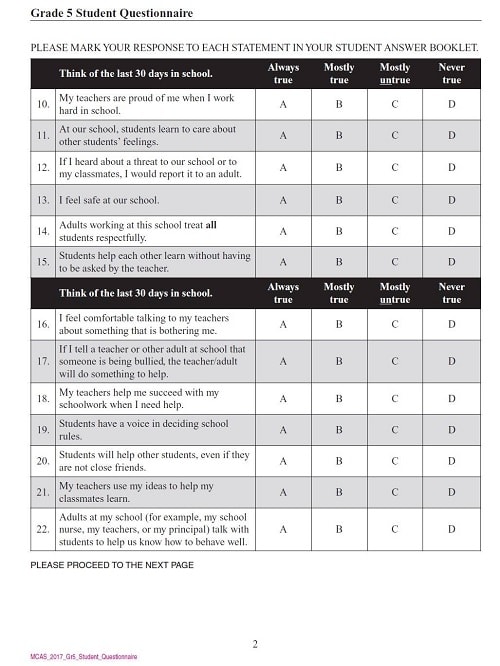
Although answering these questions at the end of the (already too long) computerized state tests is said to be optional in a document from the state education department, school districts are not notifying parents and students of the opportunity to opt out.

Jane Robbins of the American Principles Project describes some of the Georgia questions and their problems:

In addition to being asked about their feelings about school, children in grades 3-5 are queried whether they’ve been hit or kicked, targeted by rumors or threats, or picked on by being left out. In simpler times, principals and teachers handled these problems as they saw fit (in less severe cases, wisely, by allowing children to work them out on their own); now, the state bureaucracy must know about it.

But the truly objectionable questions come in grades 6-10. Some seek to ferret out positive or negative moral characteristics, by asking students to agree or disagree with statements such as “Doing the right thing is important to me” and “Honesty is an important trait to me.” The DOE claims the answers are anonymous, and given the construction of a cradle-to-career database on all students, parents should pray that’s true. What student wants a college or potential employer to discover this applicant doesn’t care about honesty?

What is the origin of this latest example of imminent danger to privacy, parental autonomy, and freedom of conscience? It is the 2015 replacement for No Child Left Behind, now called the Every Student Succeeds Act (ESSA). Despite repeated assurances that ESSA was going to get rid of federal mandates, it created a whole new set of them around this very dangerous concept. This terrible piece of federal legislation was opposed by more than 200 parent groups and education experts — primarily for this reason. (Jeb Bush’s involvement in ESSA’s composition, along with his ties to Big Data, helped sink his already failing presidential campaign.)

As many of us tried to warn Congress at the time, one of the biggest concerns with ESSA is this psychological profiling, occurring through the federally mandated Common Core tests which have been described by Emmett McGroarty as “‘brave new world’ assessments that operate more as brain maps than as tests of academic knowledge.” According to the statute, these assessments are required to test “higher-order thinking skills and understanding, which may include measures of student academic growth and may be partially delivered in the form of portfolios, projects, or extended performance tasks.” These are all extraordinarily subjective.

The law’s required testing of “higher-order thinking skills” is even more dangerous when combined with state accountability system requirements that must include measures such as “student engagement,” “School climate and safety” and “any other indicator the state chooses that meets the requirements of this clause.”

McGroarty went on to say:

As reported by Education Week“it’s not unreasonable to assume that states could use the ‘any other indicator’ language to support inclusion of students’ social and emotional skills, grit, or growth mindsets in their accountability models.

Yet, as Jane Robbins and I wrote in The Federalist last year, even the experts on these subjective and difficult-to-measure traits oppose their use in accountability systems:

Because “perfectly unbiased, unfakeable, and error-free [SEL] measures are an ideal, not a reality,” [SEL experts, Angela] Duckworth and [David] Yeager argue, such measures should not be used to evaluate schools or teachers. Duckworth was so concerned about using these highly subjective criteria in federally mandated accountability schemes that she withdrew from a California project to do just that. But this is exactly what USED is pushing through ESSA, and CASEL [Collaborative for Academic Social and Emotional Learning] through its K-12 [SEL] standards.

Why is this so dangerous? Details are HERE and HERE, but besides even the experts opposing it, here is a quick summary:

1.) It puts states and the federal government in charge of setting norms for the thoughts, beliefs and attitudes of children, which is supposed to be the job of parents and religious institutions in our constitutional republic. Government has no role, authority, or duty to do this, period.

2.) These types of surveys can be used to develop curricula and assessments that push various controversial political agendas, such as LGBT issuesenvironmentalism, and gun control, which interfere with academics and regardless of one’s point of view, should be extremely concerning.

3.) Children develop very differently and at different rates, so these kinds of surveys and assessments, which are challenged by experts as having serious validity issues, can falsely label children as abnormal or defective in some way.

4.) Data privacy and security are becoming things of the past, so having this kind of subjective and controversial data in children’s lifelong data dossiers, also created by federal law, is extremely dangerous to their freedom of conscience, privacy and futures.

5.) Not that it ever seems to matter to our federal masters, but these types of surveys also violate several parts of federal law.

This is a perfect example why parents should opt out of federally mandated state testing and, if their students have been surveyed on these issues without consent, strongly consider a lawsuit. They should also urge their members of Congress to repeal ESSA and cut the federal education budget, as proposed by the president’s budget blueprint,  on the way to eliminating the U.S. Department of Education (already proposed in two bills and a frequent Trump campaign discussion).

Let us hope that President Trump’s renewed discussion about ending Common Core and his withdrawal of an offer to a pro-Common Core candidate for deputy secretary of education are indications that he is moving in those vital and parentally desired directions.


Sent from my iPhone

Wednesday, April 5, 2017

Class size matters a lot, research shows

Class size matters a lot, research shows

Loaded in 1.15 seconds

(By Jahi Chikwendiu/The Washington Post)

Every now and then someone in education policy (Arne Duncan) or education philanthropy (Bill Gates) or the media (Malcolm Gladwell) will say something about why class size isn’t really very important because a great teacher can handle a boatload of kids.

Not really.

new review of the major research that has been conducted on class size by Northwestern University Associate Professor Diane Whitmore Schanzenbach and published by the National Education Policy Center at the University of Colorado Boulder makes clear that class size matters, and it matters a lot. Schanzanbach, an associate professor of human development and social policy at Northwestern and chair of the Institute for Policy Research’s Program on Child, Adolescent, and Family Studies, writes in the review:

Considering the body of research as a whole, the following policy recommendations emerge:
*Class size is an important determinant of student outcomes, and one that can be directly determined by policy. All else being equal, increasing class sizes will harm student outcomes.
* The evidence suggests that increasing class size will harm not only children’s test scores in the short run, but also their long-run human capital formation. Money saved today by increasing class sizes will result in more substantial social and educational costs in the future.
* The payoff from class-size reduction is greater for low-income and minority children, while any increases in class size will likely be most harmful to these populations.
* Policymakers should carefully weigh the efficacy of class-size policy against other potential uses of funds. While lower class size has a demonstrable cost, it may prove the more cost-effective policy overall.

Why do small classes work? She writes:

Answer Sheet newsletter

Education questions and answers, in your inbox weekly.

The mechanisms at work linking small classes to higher achievement include a mixture of higher levels of student engagement, increased time on task, and the opportunity small classes provide for high-quality teachers to better tailor their instruction to the students in the class.

The research is there. Class size matters. Even the finest teachers are limited in what they can do when they have large classes.

So can we stop pretending that class size doesn’t matter?

Valerie Strauss covers education and runs The Answer Sheet blog.Follow @valeriestrauss


Sent from my iPhone

Saturday, April 1, 2017

U.S. Education Department Asked to Eliminate Lesson Plans on Islam

U.S. Education Department Asked to Eliminate Lesson Plans on Islam

Win McNamee/Getty 

by Dr. Susan Berry31 Mar 20171,754

The Christian Action Network (CAN) says the U.S Department of Education is funding an Islamic education program in America’s public schools, in which students in grades 5 through 12 are taught the Islamic way of life in a way that crosses the line from academics to indoctrination.

“’Access Islam’ is funded by the Department of Education and is being promoted on various websites,” Martin Mawyer, president and founder of CAN, tells Breitbart News. “So, PBS Learning Media is one of the websites that is promoting it. The Smithsonian also promotes it, the Indiana Department of Education promotes it, and even the United Nations promotes it.”

SIGN UP FOR OUR NEWSLETTER

The “Access Islam” curriculum includes 10 lesson plans, including the “Five Pillars of Islam;” “Salat: Prayer in Muslim Life;” “Ramadan Observance;” “Quran: Sacred Scripture of Islam;” “The Haji: Journey to Mecca;” “Islam in America;” and “Women in Islam.”

Mawyer explains his objections:

When we took a look at the various lesson plans that are being offered, we thought they certainly crossed the line of anything that would be considered constitutional. When a teacher is expected to quiz their students on such questions as “What does a Muslim prayer sound like?” “What do Muslim prayer movements look like?” and “What are some of the things that Muslims say while they’re praying?” this is no longer a question of academia, it’s a question of what we would believe is religious indoctrination.

Mawyer says that, through the “Access Islam” curriculum, students in public schools in America are taught that Allah is God, at the same time they would never be taught that Jesus is God.

In a demand letter to U.S. Education Secretary Betsy DeVos, president of PBS Paula Kerger, and president of Ohio State University Michael Drake, CAN articulates its view of the discrepancies between how Islam is treated in the lesson plans, and how other faiths, such as Christianity and Judaism, are often presented in schools.

“The nature of the materials and the lack of any similar materials for other religions such as Judaism, Christianity or Hinduism demonstrate the Establishment Clause violation, because there can be no argument that the materials are for comparative educational purposes,” the letter asserts, continuing:

We demand that you immediately remove all such promoted lesson plans from the publicly funded web sites and immediately cease spending public funds on the promotion of the Islamic religious in this or any other manner. Further, we demand that Secretary DeVos issue a public announcement that the past and future use of public funds for these materials including the use of the materials in public schools violates the Establishment Clause of the United States Constitution.

Asked about the roots of the “Access Islam” program in America, Mawyer says CAN has been able to determine the curriculum was originally started by President George W. Bush in 2005.

“But at that time, it was a program that simply taught students about the traditions, culture, and holidays of Islam,” he explains. “Then, it became greatly expanded under the Obama administration. It has continued to develop, and now has had a greater, broader outreach.”

CAN has launched a petition to “dump Access Islam” from public schools in the United States.

“I am calling on all Americans to demand the Department of Education dump this program,” Mawyer says. “This is an outrageous abuse of our taxpayer dollars, and an affront to the rights of parents to teach their children the religion of their choice.”

Breitbart News received no response to a request for comment from the U.S. Education Department.


Sent from my iPhone

Thursday, March 30, 2017

Homeschooling is the smartest way to teach kids in the 21st century

Homeschooling is the smartest way to teach kids in the 21st century

kids readingMatthew Hauck/Flickr

Alison Davis doesn't see homeschooling as some strange alternative to traditional school.

If anything, says the mom from Williamstown, New Jersey, when it comes to raising her two children, she's doing the sensible thing.

"You're not going to be put in a work environment where everybody came from the same school and everybody is the same age," she tells Business Insider. "In my opinion, the traditional school atmosphere is not the real world at all."

Homeschooling, she says, that's the real world.

Davis' satisfaction with keeping her kids out of local public and private schools is one shared by a growing pool of parents around the US. Recent data   collected by the Department of Education reveals homeschooling has grown by 61.8% over the last 10 years to the point where two million kids - 4% of the total youth population - now learn from   the comfort of their own home.

Contrary to the belief that homeschooling produces anti-social outcasts, the truth is that some of the most high-achieving, well-adjusted students are poring over math problems at their kitchen table, not a desk in a classroom. According to leading pedagogical research, at-home instruction may just be the most relevant, responsible, and effective way to educate children in the 21st century.

Personalization is key

In his 2015 book "Creative Schools: The Grassroots Revolution That's Transforming Education," veteran teacher and beloved TED speaker Ken Robinson emphasizes that students learn best at their preferred speeds and in their preferred manner. "All students are unique individuals with their own hopes, talents, anxieties, fears, passions, and aspirations," he writes. "Engaging them as individuals is the heart of raising achievement."

Robinson wasn't referring to homeschooling directly, but he might as well have been. No form of education is designed to foster more personalized tutelage.

While traditional schools try their best to tailor lesson plans to individual students, teachers often still end up teaching to the middle. There are simply too many kids learning at different speeds for teachers to give each of them exactly what they need. Homeschooling, meanwhile, is personal by design.

dad kidKelly Sikkema/flickr

Davis says her son Luke struggled early on with reading. Even into the second grade, he didn't enjoy it and found it overwhelming. In any other school, teachers may not have been able to spend the necessary time helping Luke become a stronger reader because they had 20 other kids to worry about. That's not the case in the Davis household.

"I could take that extra time with him," Davis says. Plus,   reading time became more than just a push toward literacy; it was Mommy-Luke bonding time - something no school could compete with. "Now he devours books in like a week's time or less," she says.

The long-term effects of personalization are equally massive. According to a 2009 study of standardized testing, homeschoolers scored in the 86th percentile. The results held true even when controlling for parents' income level, amount of education, teaching credentials, and level of state regulation. Research also suggests that homeschooled kids get into college more often and do better once they're enrolled.

No, homeschooling doesn't create recluses

The biggest stereotype surrounding homeschooling is that constant one-on-one teaching deprives kids of the socialization they need to thrive. Not so. Homeschooled kids are just as likely to play soccer and do group projects as any other students.

Davis' family is heavily involved in their local church, so Luke and his older sister Amanda both have friends in the choir. They both play an instrument, so they have friends in a homeschooler orchestra. They hang with kids on their block. Amanda has a pen pal who lives in Arizona. As far as childhood goes, theirs is pretty run-of-the-mill.

KidsLibrary of Congress, Prints & Photographs Division. Dr. Alice S. Kandell Collection of Sikkim Photographs

It's not just that homeschooled kids enjoy the upside of normal school, though; they also get to enjoy the absence of its many drawbacks - namely peer pressure and cliques. On several occasions, Alison says, other kids have expressed jealousy that Luke and Amanda get to learn at home, away from the social hierarchies of normal school.

"They're like, Aw man, I wish I got be homeschooled," she says. "I've been very surprised by it."

Of course, some parents do struggle to help their kids make friends.

Earlier this year, I interviewed an extremely bright 7-year-old named Akash who lives in San Angelo, Texas. He's homeschooled because a child psychologist who studied him when he was a toddler told his parents it was probably the smartest option.

Akash's best friend - maybe his only friend - is his big sister, Amrita. Most of the kids in his nearby homeschoolers' association are either too old or too dissimilar in personality for his parents to schedule regular playdates, even though Akash is silly and outgoing. 

But even for kids who do struggle, trends suggest the Internet is making it easier. A Pew survey from last year revealed that 55% of all teens say they regularly spend time with friends online or through social media, and 45% say they meet through extracurriculars, sports, or hobbies, which suggests classrooms aren't the only way to make friends.

South Korean teenagers sit in a classroom during their physical examination for conscription at the South Korean Military Manpower Administration on January 27, 2005 in Seoul, South Korea. According to the Military Manpower Administration, 310,000 young people join the Armed Forces every year once they have reached the conscription age of 19. (Photo by Chung Sung-Jun/Getty Images)Chung Sung-Jun/Getty Images

Schools are even more over-worked than students

As stressed-out as students may be, schools may be under even more pressure to perform. We expect schools to help kids become smart but not anti-social, physically fit but not dumb jocks, self-reliant yet cooperative, and creative while also college-ready.

Whether we accomplish that goal is debatable - a recent survey of 165,000 high school students, for instance, found fewer than half felt prepared for college and beyond.

Maybe that's because a lot of the responsibilities we heap onto schools are jobs better suited for parents. Perhaps Alison has found such success with Luke and Amanda because she can hack through the busy work and red tape and just focus on what her kids need.

"Schools have to bring in all these extra testing and courses and electives to try to make it resemble the real world," she says. "But that can never happen unless you're actually living in it."


Sent from my iPhone

Wednesday, March 29, 2017

Rep. Massie: “Department of Education shall terminate on December 31, 2018.”

Rep. Massie: “Department of Education shall terminate on December 31, 2018.”

Here’s hopeful news for freedom lovers.

Eight congressmen have banded together to try to restore the constitution by deleting the federal Department of Education.

President Ronald Reagan, while in office, aimed to make this happen. Recently, parent and educator groups have been pleading for this to happen. Campaigners have often spoken about this idea, since it guaranteed applause from voters.  However, last month, in a clear, one-sentence-long bill, eight congressmen actually wrote the bill to take down the Fed-Ed monster.

It says only this: “The Department of Education shall terminate on December 31, 2018.”  That’s it.  That’s the whole bill.

It’s short, but it’s powerful.  H.R. 899 (if it gets a hearing and a vote) ends the reign of the unconstitutional, federal department, and aims to restore money and power to the states. –Remember, the Constitution’s Tenth Amendment states: ” The powers not delegated to the United States by the Constitution, nor prohibited by it to the States, are reserved to the States respectively, or to the people.”

Original H.R. 899 sponsors are: Rep. Thomas Massie of Kentucky (twitter:  @RepThomasMassie ) Rep.  Jason Chaffetz of Utah,  Rep. Justin Amash of Michigan, Rep. Andy Biggs of Arizona,  Rep. Matt Gaetz of Florida, Rep. Jody Hice of Georgia, Rep. Walter Jones of North Carolina, and Rep. Raul Labrador of Idaho.

Rep. Massie said in his press release, “Neither Congress nor the President, through his appointees, has the constitutional authority to dictate how and what our children must learn… Unelected bureaucrats in Washington, D.C. should not be in charge of our children’s intellectual and moral development. States and local communities are best positioned to shape curricula that meet the needs of their students. Schools should be accountable. Parents have the right to choose the most appropriate educational opportunity for their children, including home school, public school, or private school.”

Original co-sponsor Rep. Walter Jones agreed: “For years, I have advocated returning education policy to where it belongs – the state and local level. D.C. bureaucrats cannot begin to understand the needs of schools and its students on an individual basis. It is time that we get the feds out of the classroom, and terminate the Department of Education.”

Co-sponsor Rep. Raul Labrador added: “I’ve always been a proponent of empowering parents, teachers and local school boards who best know our children and their needs. Eliminating the U.S. Department of Education is the most important step we in Congress can take in returning decision making to the local level.”

Co-sponsor Rep. Andy Biggs noted: “Education of our students should lie primarily with parents, teachers, and state and local officials who know how to meet their individual needs best. Since its inception, the Department of Education has grown into an unrecognizable federal beast, and its policies have helped foster Common Core across the country. It is time the one-size-fits-all approach by the federal government is ended and authority is returned to the local level.”

Rep. Massie also pointed out that President Ronald Reagan would have cosponsored this bill.  In September 1981, about a year after the federal Department of Education began operating (1980) President Ronald Reagan said:

“…[W]e propose to dismantle two Cabinet Departments, Energy and Education… [E]ducation is the principal responsibility of local school systems, teachers, parents, citizen boards, and State governments. By eliminating the Department of Education less than 2 years after it was created, we cannot only reduce the budget but ensure that local needs and preferences, rather than the wishes of Washington, determine the education of our children.”

Learn more about the bill in the video interview with Rep. Massie below. In the video, when answering a question about who now opposed his bill,  Massie said that there are opposers who believe that D.C. has cornered the market on genius, who feel that the rest of America should rely on those situated in D.C.; but most people want to keep educational decision-making and education money local; opposers are few.

Please remember that the bill, H.R. 899, newborn last month, has yet to have a hearing or a vote.  Please contact your congressional representatives  to add momentum to this bill.

How will the Department of Education be dismantled?

Rep. Massie envisions three ways in which the bill could be implemented.

1.  Get rid of federal education.  Return all power and all money to the states.

2.  Block grant federal education money to the states.

3.  Have different federal departments oversee federal education programs that are still active due to federal law.

Massie favors the option that gets rid of fed-ed altogether, and so do I.

Advertisements


Sent from my iPhone

Wednesday, March 22, 2017

5 types of school choice: Which has the least government involvement?

5 types of school choice: Which has the least government involvement?

Blog post featured image
iStock/fernandogarciaesteban

School choice is all about giving consumers variety. But lo and behold, there are actually varieties of school choice.

In some types of school choice (like open enrollment programs and charter schools) the government plays a big role. And in others (like voucher programs and education savings accounts) not so much.

Here are the 5 common types of school choice, in order from most to least government involvement, with a description of how each works.

#1

First, there are open enrollment programs, sometimes known as “public school choice.” This means that families can choose from many different public schools, as opposed to being assigned a public school based only on zip code. In certain states, there is “mandatory” open enrollment for students in areas the state considers low performing, where students in those underperforming areas can transfer to other districts (pending state approval).

Several states also allow for “voluntary” open enrollment, meaning that districts who agree to participate can allow students from other districts to choose into that district, or students from that district to choose into another participating district. (For instance, if I am a student in one district who allows open enrollment, I could choose to attend a school in another district as long as they allow open enrollments too.)

While this is certainly a kind of school choice, it is limited in several ways. First, this choice is limited to public schools. Second, those wanting to take advantage of it generally have to fill out an application that the state must approve, and the state can regulate who may and may not apply as well as who gets priority.

#2

Next, there are charter schools. Charters are privately run schools that agree to be part of the public school system in order to provide students some choice. Since these schools are privately run, they are often exempt from some of the constraints of traditional public schools (they can structure their daily schedules and teacher contracts any way they like). But since they are part of the public system, they receive tax money (rather than tuition) and generally their students must take the same standardized tests and follow the same curricular standards as other public schools.

Each state government also controls how many charters will be allowed in it, which organizations gain a charter, and when a charter should close. So, while charters do offer choice, technically that choice is still within the public system, and there is a sizable government role.

#3

Voucher programs provide more choice and less role for the state. In a voucher system, the state gives vouchers to families in proportion to their number of school-age children. The families can use those vouchers to purchase schooling from any private school eligible to receive voucher money (including many religiously themed schools).

Most voucher programs are targeted, either only available for students in certain (generally poor urban) regions, or to families below a certain income level. Unlike with charters, schools that accept vouchers are private schools who accept tuition money directly from the parents. The government still has a role, though, in determining which private schools may be eligible for voucher money.

#4

Scholarship tax credits function in a similar way to vouchers, but with a more convoluted accounting method. The main difference is that the money is not dispensed to families or schools by the government. Instead, the family generally gives money to a “scholarship fund” for their child, then receives an equivalent tax credit from the government. (Corporations can also donate money to scholarship funds that students in general are eligible for.)

These scholarships then pay tuition at eligible private schools. The state’s role is similar to what it is in a voucher system, as the state determines the rules for scholarship-granting organizations and for what schools are eligible to receive scholarship money.

#5

Probably the least government-heavy system of school choice that currently exists is the education savings account. ESAs allow families to use money designated by the government for their child’s education for private educational services. (Parents can generally contribute additional money to the child’s educational savings account.)

They can use this money not only for school tuition but also for other educational services like online courses, tutoring, private lessons, or educational technologies (for instance, technologies that aid students with disabilities to access educational services). Also, any money the family doesn’t use one year rolls over to the next. While the state oversees how the money is spent in order to guard against fraud, this is a much less active role than in a voucher or tax-credit system.

This system gives families very wide choice and keeps government decision-making to a minimum.

In my view, any school choice is better than no school choice. But not all school choice is structured the same way. It is important that we keep in mind the differences in types of school choice, and that some of these models require much more government involvement than others.


Sent from my iPhone

Tuesday, March 14, 2017

Not Another Test… The Right Test

Please read this info-article in its entirety and share it widely. It confirms exactly what I have found while mentoring the "new" GED materials. David Coleman, President of the College Board that oversees the SAT, was a champion of and contributor to the Common Core curriculum which aligns itself with the premier college aptitude test. The alignment of these two academic mandates has created a financial monopoly that is genius, but toxic. Blatant liberal ideology is being injected into every crevice of academia and it is all directly aligned with any hopes of scoring well on the current college aptitude tests, primarily the SAT. No one escapes this higher education shackle, not the private, Christian, or the Charter school. All must rely on college ready testing to get into what is advertised as the only hope for a promising future. It is diabolical. 

The writer of the following article states, "As I began to immerse myself in the SAT, I was shocked to discover how much the test had changed since I graduated from high school in 2000. The most salient aspects of the SAT that I remembered had disappeared. The infamous analogies had been replaced with reading passages that were often politically charged and almost always championed the views of the political left." 

Not Another Test… The Right Test

The Classic Learning Test (CLT) is a new alternative to the SAT and ACT. By creating a new standard that is distinctly Western and drawn from the richness of our intellectual heritage, the CLT hopes to encourage secondary schools to return to teaching the great classics…

James_Campbell_-_News_from_My_Lad_-_Google_Art_ProjectThe Classic Learning Test (CLT) is a new alternative to the SAT and ACT.  In a test-saturated educational environment, one might ask: why is another college admissions test needed? The best way I can answer this question is to tell you the story of how the CLT came to exist.

In 2014, after graduating from seminary and spending a few years in the public school system, I accepted a job as a college counselor at Mount de Sales Academy in Catonsville, Maryland. At the same time, to supplement my income for a growing family of six, I began a SAT Prep company.

As I began to immerse myself in the SAT, I was shocked to discover how much the test had changed since I graduated from high school in 2000. The most salient aspects of the SAT that I remembered had disappeared. The infamous analogies had been replaced with reading passages that were often politically charged and almost always championed the views of the political left. For example, I came across one reading passage from a 2013-14 SAT practice test which featured a passage from Susan Glaspell’s novel, The Glory of the Conquered. In the novel, Glaspell, an early feminist, presents marriage and family life as simply the total loss of freedom. I would have found no reason to complain if this passage had been countered by other reading passages that reflected on the sacredness, beauty, and wonder of marriage and family life. However, every passage that touched on the subject reflected a similar perspective to Glaspell’s. As a former teacher, I understood that tests don’t just evaluate – they teach. Tests are inherently pedagogical. In using this passage (and many similar passages), what was the SAT teaching our students about the reality of truth, the beauty of family life, and the dignity of the human person?

At the same time, my role as a college counselor opened my eyes to another major role that the SAT and ACT play in higher education. Not only are they college entrance exams, they are also college match-makers. As a college counselor, I had several experiences working with students who initially wanted to attend a small liberal arts college. However, after taking the PSAT, SAT, or ACT, these students would get flooded with junk mail from large state universities. Their names and contact information had been sold on the open market, and the colleges with the best marketing machines would end up getting the students. Sometimes the junk mail would include a personal letter from a college admissions representative, and often the student would end up committing to a large research university instead of a small liberal arts college.

These students’ decisions not to attend a liberal arts college was often compounded by input from parents who would tell me, “my son (or daughter) will need a job after college – and the future is in STEM.” STEM (Science, Technology, Engineering, and Mathematics) has been a buzz word in education for the past several years. The CLT loves math and science, but serious people recognize that STEM is not simply about math and science. David Wagner, co-founder and CEO of the Classic Learning Test, spent more than a decade in the health care industry before co-founding the CLT. Mr. Wagner has drawn attention to the lobbying efforts of big pharmaceutical companies who seek to undercut their own product development costs by having research universities do it for them. This is one of the origins of the STEM propaganda narrative, which is now being pushed by both the SAT and ACT. The STEM narrative asserts that most of the good jobs in the future will come from STEM majors. This claim contradicts the consistent insight of many of America’s top business leaders who see the liberal arts as the future. Steve Jobs once said that “It is in Apple’s DNA that technology alone is not enough — it’s technology married with liberal arts, married with the humanities, that yields us the results that make our heart sing.” In a recent interview, billionaire Mark Cuban echoed the same viewpoint, stating his belief that in a decade, there will be a greater job market demand for students with liberal arts majors than students with programming or engineering majors.

Nonetheless, many liberal arts colleges are suffering a downturn in enrollment as students continue to flock to large research universities. The CLT hopes to change this reality. Just as the SAT and ACT play in the arena of college match-making, the CLT endeavors to do the same. However, we at the CLT believe that the best colleges are the colleges that have held onto a traditional understanding of education. In the West, education has historically been focused on the cultivation of virtue and wisdom and not on the nebulous idea of making someone “career ready.” Paradoxically, when colleges focus on cultivating true character and virtue in young people, they end up graduating students who are far more “career ready” than students coming from universities that fail to educate the whole person.

To date, CLT has been adopted by forty colleges, all of which offer a strong liberal arts program. However, for the CLT to truly compete against College Board (SAT) and the ACT, we will need widespread adoption of the new test from like-minded parents and students. Every college to date that has taken the time to do a thorough review of the CLT has adopted it as a third option. It is the only college admissions test offered which is not aligned with common core standards and it is the only test that has retained elements of a true aptitude test. In fact, Hillsdale College, after an extensive six-month review of the CLT, noted that as an aptitude test, the CLT was “superior.” To the extent that the CLT is an achievement test, it measures mastery of better content. Rather than relying on meaningless texts that nobody would read if he or she was not taking a standardized test, the CLT puts students in front of the greatest thinkers in the history of Western thought. By creating a new standard that is distinctly Western and drawn from the richness of our intellectual heritage, the CLT hopes to encourage secondary schools to return to teaching the great classics.

To answer my initial question of why another college admissions test is needed, we at the CLT respond thus: another test isn’t needed. The right test is needed: a test that embraces the values inherent in our intellectual heritage, is free from common core political agendas, and remains committed to testing aptitude.

View a full-length practice CLT here and consider sending this essay and this link to a young person who may benefit from this new test. Unlike the SAT and ACT, the CLT allows students to send unlimited scores to colleges for free. The test is online and students who test receive their scores on the same day. The deadline to register for the March 18th CLT is March 14. We believe that the CLT is part of a movement to reconnect knowledge and virtue.

Please consider joining us.

Books on the topic of this essay may be found in The Imaginative Conservative Bookstore.


Sent from my iPhone